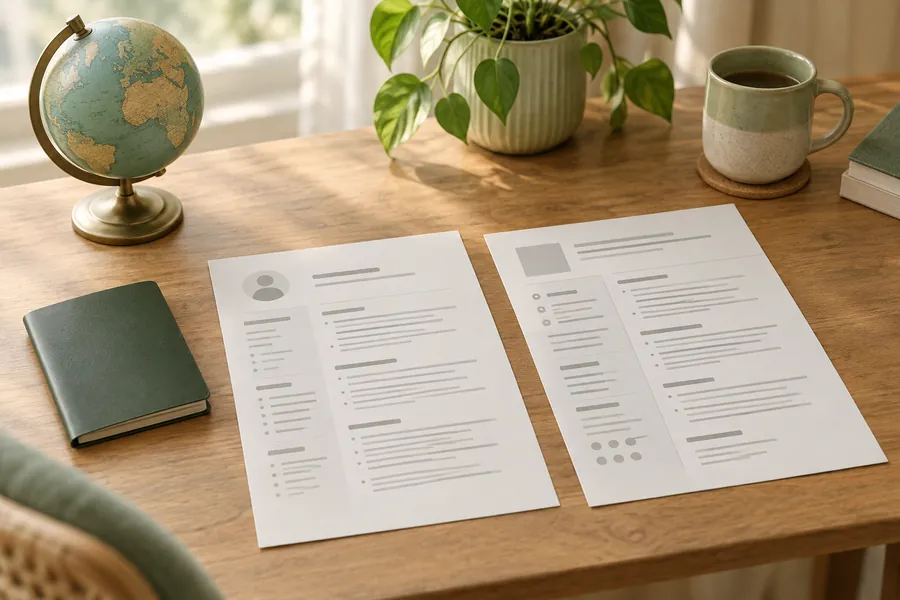
Employers in different countries and sectors use the words CV and resume differently. A website for a worldwide audience should not turn one market's conventions into a universal rule. Begin with the job's instructions and the country where you are applying.
Use the advert as your starting point
Look for the requested document type, language, format and any length guidance. An academic application may ask for a detailed record of research, teaching and publications. A short job-application document serves a different purpose. This starter is designed for ordinary job applications, not a complete academic CV.
Compare relevant guidance
The UK's National Careers Service describes a CV as a summary of skills, achievements and experience used to apply for jobs. The US CareerOneStop resume guide covers contact information, summary, skills, work experience and education. These sources overlap on useful sections, but they should not be treated as complete advice for every country.
Be careful with personal details
Photos, age, full addresses and other personal information require particular care. UK guidance explicitly advises against including age, date of birth, marital status or nationality. Before adding such details elsewhere, check local careers guidance and whether the employer needs them. Do not assume that a field appearing in an online template makes it necessary.
Explain unfamiliar qualifications
Use the accurate name of a qualification and institution. If a translation or explanation would help the reader, make clear what it is. Do not claim an official equivalence that has not been established. Keep the original facts available so you can explain them if asked.
Prepare for the right audience
Use the language requested by the employer and proofread it carefully. Make dates unambiguous. Give international contact details when needed and check that portfolio links can be opened. A worldwide document is not one that includes everything: it is one adapted carefully to the particular application.
Know this starter's limits
The first version of this site is in English and offers general job-application guidance. It does not provide country-by-country legal advice, official qualification assessments or guaranteed recruitment-system compatibility. More local guides should be researched and reviewed before being added.
Sources and scope
Original general guidance informed by careers resources. Reviewed 10 October 2026. Employer instructions and local expectations take priority. No interview, hiring or ATS result is guaranteed.
Put it into practice.
Write a first draft in your own words, then review it carefully.
Start your CV ↗