 CVPebble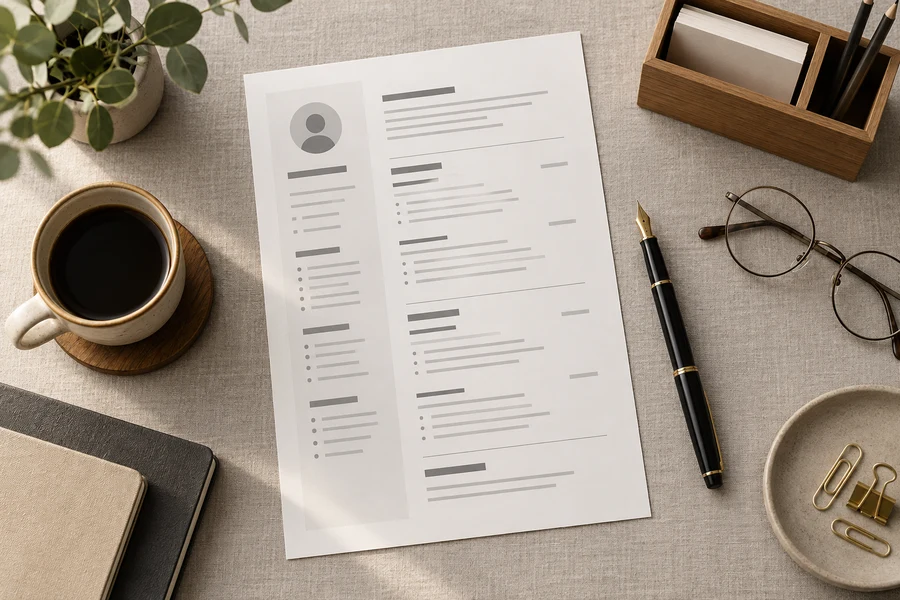
Applying in Germany means writing a Lebenslauf, the German CV, and it follows conventions that differ from both the UK CV and the US resume. German applications are expected to be complete, careful and well documented. This guide collects the conventions that matter most, checked against the Bundesagentur für Arbeit, Germany's federal employment agency, whose international placement service publishes application guidance for candidates from abroad. Where practices vary between employers, we say so.
What German employers expect, in short
A German CV is usually a clean tabular document of no more than two pages, in reverse chronological order, with month-and-year dates for every stage. A professional photo is common, though no longer mandatory, and the document traditionally ends with the place, date and your signature. The CV comes as part of a complete application: a cover letter tailored to the role, plus certificates and references as evidence.
Length and structure
Two pages is the accepted maximum, and the federal agency's guidance is explicit about it. Within each section, list the most recent stage first. The standard order is personal details, professional experience, education, further training and certificates, language and IT skills, and finally interests, but only interests that say something relevant about you, such as volunteering or club membership. Soft skills like teamwork belong in the cover letter, not the CV.
The experience and education sections
For each role give the start and end dates (month and year are enough), the employer, your position, and three to five bullet points on your concrete tasks and results. Focus on what is relevant to the advertised position rather than listing everything. For education, your highest or most recent qualification is sufficient; you do not need to list every school you attended. Certificates and further training belong in their own section when they are relevant to the role.
The photo question
Since Germany's General Equal Treatment Act (AGG) came into force in 2006, employers may not require a photo, and you are free to apply without one. In practice, the federal agency notes that most employers still expect one. If you include a photo, use a professional application photo placed at the top of the CV or on a cover sheet: a friendly, well-lit, businesslike portrait, not a holiday crop. If you prefer not to include one, that is a legitimate choice and a complete application works without it.
Personal details
Start with your full name, address, phone number and email. Applying from abroad, include the correct country code and contact details where you can actually be reached. Date and place of birth are traditional on German CVs but no longer required. Marital status and religious affiliation are not required either, unless you are applying to an employer with a particular religious affiliation where it matters to the role.
Date and signature
A German CV traditionally closes with the place, the current date and your signature. This confirms the document is up to date and accurate. It is a small convention, but omitting it can read as incomplete to a German reviewer, so keep it.
Certificates and evidence
German application culture values documented evidence. Relevant certificates (vocational training, courses, language certificates) strengthen an application, and the highest certificate per language is enough. Work references from previous employers, the Arbeitszeugnisse, are a standard part of a complete German application, so collect them as you go. Foreign applicants do well to name their certificates clearly and, where needed, note the rough equivalent in the German system.
Language
German language skills are a real advantage, and the federal agency recommends applying once you have reached the level the role requires, often B1 or B2 for German-speaking workplaces. International companies and many tech employers hire in English, so read the language of the posting and apply in the language it uses. List your languages with honest levels rather than vague labels.
Portals and patience
Many large German employers recruit through their own online portals: structured questions about the position, a text field for your motivation, then document uploads. Enter information carefully, because what you type into the portal must agree with the CV you upload. And plan for patience: German employers often review applications thoroughly and take time to reply, and unfortunately no reply at all is common. Send your application only when it is complete.
Applying in the UK, the US or Canada instead? The conventions differ: see writing a CV for the UK, writing a resume for the US and writing a resume for Canada.
Frequently asked questions
Is a photo required on a German CV?
No. Since the AGG, a photo cannot be demanded. But it is still widely expected, so decide consciously: a good professional photo helps, a bad one hurts, and none at all is acceptable.
Do I need to write my CV in German?
Follow the posting. A German-language posting expects a German application; an English-language posting at an international employer expects English. When in doubt, German is the safer choice for German-speaking workplaces.
Is the Europass format accepted?
The Europass template is a solid basis and widely understood, but the federal agency notes that many employers prefer a more individual layout. A clean, well-structured design of your own stands out more.
Sources and scope
This guide, “Writing a CV for Germany: conventions that matter”, is original general guidance informed by careers resources. Reviewed 10 October 2026. Employer instructions and local expectations take priority. No interview, hiring or ATS result is guaranteed.